The OPPO A6x 5G, launched in early 2026, is an affordable smartphone designed for users who want strong battery life and smooth everyday performance. It features a large 6100mAh battery, a 120Hz HD+ display, and is powered by the MediaTek Dimensity 6300 processor. The device also includes a 50MP main camera, durable IP64 dust and water resistance, and runs on ColorOS 15.
Key Specifications & Features
Performance The phone is powered by the MediaTek Dimensity 6300 5G chipset and comes with up to 8GB RAM and 256GB internal storage, delivering reliable performance for daily tasks and multitasking.
Display It features a 6.75-inch LCD display with a 120Hz refresh rate, providing smooth scrolling and a large viewing experience with around 90.6% screen-to-body ratio.
Camera The rear camera setup includes a 50MP main sensor paired with a 2MP monochrome camera. For selfies and video calls, the phone offers a 5MP front camera.
Battery A massive 6100mAh battery powers the device, ensuring long usage throughout the day. Some regions may offer a 6500mAh version, and the phone also supports reverse wired charging.
Durability With an IP64 rating, the device is resistant to dust and light water splashes.
Software The phone runs ColorOS 15 based on Android 15, offering improved performance, security, and new software features.
Design The device has a 212g weight and 8.61mm thickness, giving it a solid yet comfortable feel in hand.
Key Highlights
Long-Lasting Battery: High-capacity battery designed for extended daily use.
48-Month Fluency Protection: Optimized to maintain smooth performance for up to 4 years.
AI LinkBoost 3.0: Enhances network stability and connectivity.
Outdoor Mode 2.0: Improves screen visibility in bright sunlight and supports glove touch operation.
Xiaomi’s transition from MIUI to HyperOS was a massive shift toward a “Human x Car x Home” ecosystem. While HyperOS 3.0 laid the foundational architecture, the HyperOS 3.1 update is the “polish” phase, focusing on eliminating micro-stutters, improving cross-device latency, and leaning harder into Generative AI. 🔄 HyperOS 3 vs. HyperOS 3.1: Key Comparisons The jump from 3.0 to 3.1 isn’t just a version number increase; it’s a shift toward better resource management.
Performance & Core Architecture
HyperOS 3: Focused on the “Xiaomi HyperCore” to reduce background power consumption and improve cold-start speeds for apps.
HyperOS 3.1: Introduces Parallel Computing 2.0. This allows the CPU and GPU to handle complex UI rendering tasks more efficiently, specifically targeting “micro-lags” when switching between heavy apps or scrolling through media-rich feeds.
AI Integration
HyperOS 3: Introduced basic AI features like “AI Portraits” and “AI Expansion” in the gallery.
HyperOS 3.1: Upgrades to Xiaomi HyperMind 2.0. The AI now learns user patterns more aggressively—for example, if you always turn on “Do Not Disturb” at the gym, the system will offer to automate that based on location and biometric data from your Xiaomi Watch. It also adds real-time AI subtitles with better translation accuracy for third-party meeting apps.
Visuals & UI Customization
HyperOS 3: Brought the “Vibrant” and “Art” lock screen styles.
HyperOS 3.1: Refines the Dynamic Notch (Xiaomi’s version of the Dynamic Island) to support more third-party music and delivery apps. It also introduces “Fluid Cloud” notifications that are less intrusive during gaming. 📱 Eligible Devices for HyperOS 3.1 The rollout is happening in waves, prioritizing the latest flagships and the Redmi K-series (often rebranded as Poco/Xiaomi T-series globally). Xiaomi Series
Xiaomi Pad 6S Pro 12.4, Xiaomi Pad 6, Redmi Pad Pro. 🚀 Why the Update Matters HyperOS 3.1 is specifically designed for the Xiaomi SU7 electric vehicle integration. If you own a Xiaomi phone and a Xiaomi car, 3.1 allows for near-zero latency when casting your phone screen to the car’s dashboard, essentially turning your vehicle into a giant extension of your mobile device. Would you like me to check if your specific model has a confirmed release date for your region?
📱 What is KineMaster Pro? KineMaster Pro is an enhanced version of the mobile video editing app KineMaster. It’s designed to give users access to advanced editing tools and premium features — like multi-layer editing, green-screen effects, transitions, and more — without typical restrictions. Many versions circulating online remove ads and the watermark so videos look more professional when exported.
🎬 Key Features
No Watermark: Exports clean videos without the “Made with KineMaster” tag — important for professional content and social media.
Premium Assets: You get exclusive transitions, fonts, music, effects, and stickers for richer, more dynamic videos.
Chroma Key/Green Screen: Lets you remove or replace the background behind subjects for creative edits.
Multi-Layer Editing: Stack multiple video clips, images, text, and audio tracks in one project.
High-Resolution Export: Support for exporting videos in up to 4K quality on compatible devices.
Audio Tools: Includes voiceovers, sound effects, audio mixing, and speed controls.
✨ Why Creators Like It Many creators use KineMaster Pro — especially for YouTube, Instagram Reels, TikTok, and other social media videos — because it lets them produce polished, professional-looking content right from their phone or tablet.
⚠️ Important Notes 🔹 KineMaster Pro versions floating online are often modified unofficial APKs, meaning they’re not from the official app stores and may carry security risks. Always be cautious about where you download apps. 🔹 The official KineMaster Premium version (from app stores) also removes watermarks and unlocks advanced tools through a subscription plan.
If you want, I can also explain how to use its basic features (like trimming, adding music, transitions, etc.) step-by-step!
LOFIC stands for Lateral Overflow Integration Capacitor. It’s an advanced feature in modern CMOS image sensors (the “chips” that capture light in smartphone and other cameras) designed to dramatically improve high dynamic range (HDR) imaging. In simple terms, it allows the camera to handle extreme differences in brightness within a single scene—capturing details in both very dark shadows and very bright highlights—without losing information or creating overexposed “blown-out” areas.
Traditional camera sensors have a limited “bucket” (called full-well capacity) for storing light-generated electrons in each pixel. When too much light hits a pixel (e.g., the sun or bright sky), the bucket overflows, and those extra electrons are lost, resulting in clipped highlights (pure white with no detail). LOFIC solves this by adding a large secondary capacitor next to the main photodiode in each pixel. Excess electrons “overflow” laterally into this capacitor instead of being discarded.
Here’s a basic pixel cross-section diagram for illustration: 1 “LARGE”
(This shows a LOFIC pixel structure where overflow charge is captured in the additional capacitor.)
How LOFIC Works: Step-by-Step Explanation
Light Capture:
Each pixel’s photodiode converts incoming light into electrons, just like a normal sensor.
In moderate or low light, electrons stay in the main photodiode.
Overflow in Bright Light:
When light is extremely bright, the photodiode fills up quickly.
Instead of losing excess electrons (causing overexposure), they overflow into the built-in lateral capacitor. This capacitor has much higher capacity, allowing the pixel to store far more electrons overall—often achieving 100-120 dB or more dynamic range in a single exposure (no need for multiple shots merged via software).
Dual Conversion Gain (DCG) Integration:
LOFIC is often paired with Dual Conversion Gain (DCG) technology (pioneered and used by companies like OmniVision).
DCG allows the sensor to read the same pixel twice: once with high conversion gain (sensitive for low light, low noise in shadows) and once with low conversion gain (for bright areas).
Combined with LOFIC, this creates exceptional HDR: clear shadows + detailed highlights + high signal-to-noise ratio.
Readout and Image Processing:
The sensor reads data from both the photodiode and the overflow capacitor.
Software combines them into one image with ultra-wide dynamic range, often rivaling professional cinema cameras (up to ~20 stops in prototypes).
The “Variable Aperture” Effect
In very bright scenes, the overflow mechanism effectively reduces the sensor’s sensitivity to light (by shunting excess charge away). This mimics the behavior of a mechanical variable aperture lens closing down (e.g., from f/1.6 wide open to a narrower effective f/4.5):
Prevents blown-out highlights and glare.
Improves sharpness and detail in bright areas.
All without any moving parts—purely electronic and per-pixel.
This is why LOFIC delivers “cinema-level” quality: natural-looking high-contrast scenes with less halos, better color, and reduced flare.
Here’s an example comparison photo showing HDR improvement (details preserved in bright windows/sun and dark interiors): 4 “LARGE” 5 “LARGE”
Benefits and Real-World Impact
Ultra-High Dynamic Range: Single-exposure HDR avoids motion artifacts (ghosting) common in multi-exposure HDR.
Better in Extreme Lighting: Sunsets, backlit portraits, indoor/outdoor transitions look more realistic.
Reduced Glare and Blooming: Less “halo” around bright lights.
Cinema-Quality Video/Photos: Approaching human eye or pro camera performance.
LED Flicker Mitigation (in automotive uses, but beneficial for video too).
Adoption in Smartphones
Major brands are integrating LOFIC (often via OmniVision’s TheiaCel tech or similar):
Xiaomi: Already using in models like Xiaomi 17 series/Ultra.
Huawei: In Pura/Mate flagships.
Apple: Developing custom LOFIC sensors, potentially debuting in iPhone 18 (2026) or later (up to 2027-2028 for full rollout).
Others like Vivo, OPPO, Honor, and even Samsung are planning or testing it for 2026+ flagships.
This technology is pushing smartphone cameras closer to professional gear, especially for HDR photos and video in challenging light.
Hello! This list is simply a breakdown of different Xiaomi devices (phones and tablets) that are likely being talked about in an update or support announcement. Here is the list reorganized and simplified:
📱 Xiaomi & Redmi & Poco Phones This section lists various smartphones from Xiaomi, Redmi, and Poco. The phones are generally grouped by the series they belong to. Xiaomi Flagship/Main Series Xiaomi 13T: A premium/high-end model. Xiaomi 13 Lite: A slightly simpler/more affordable version of the 13 series. Xiaomi 12 Pro: The top-tier model from the previous generation (Xiaomi 12 series). Xiaomi 12: The standard model from the previous generation. Xiaomi 12T Pro: A powerful phone focused on features like fast charging and high-resolution camera. Redmi Note and Redmi Main Series (Mid-Range/Value) REDMI Note 14 5G REDMI Note 14S REDMI Note 13 Pro+ 5G (The most advanced Note 13) REDMI Note 13 Pro 5G REDMI Note 13 5G (The standard Note 13 with 5G) REDMI 15 5G REDMI 15C 5G REDMI 15C (A more budget-friendly model) Poco Series (Focused on Performance/Value) POCO F5 Pro (High-performance model) POCO F5 POCO X6 POCO M7 Pro 5G POCO C85 (A more budget-focused model)
💻 Tablets This section lists different tablet models. REDMI Pad Pro (Standard and 5G versions) REDMI Pad SE 8.7 (Standard and 4G versions) POCO Pad
📝 Important Note The list of supported models and update schedule may be adjusted as needed. For the latest details on models and timing, please refer to the Xiaomi Community In simple terms: This list is not final! Xiaomi might change which devices get an update, or when. Check the official Xiaomi Community for the most current information.
Would you like me to find the latest updates for any of these specific models?
To remove dark circles at home, use cold compresses with cucumber slices, tea bags, or a cold cloth to reduce puffiness and constrict blood vessels. Improve your lifestyle by getting adequate sleep, elevating your head with an extra pillow at night, and managing allergies. You can also gently massage the area with nourishing oils like almond or rose hip oil, or apply aloe vera gel before bed.
Immediate relief and lifestyle changes
Cold compress: Apply chilled cucumber slices, cold tea bags (preferably caffeinated), a cold wet cloth, or cold spoons to the eye area for 5-15 minutes to help constrict blood vessels and reduce puffiness.
Elevate your head: Use an extra pillow to keep your head elevated while sleeping to prevent fluid from pooling under your eyes.
Increase sleep: Aim for at least seven hours of sleep per night to prevent dark circles caused by fatigue.
Treat allergies: Address any seasonal or environmental allergies that can cause nasal congestion, which may lead to dark circles.
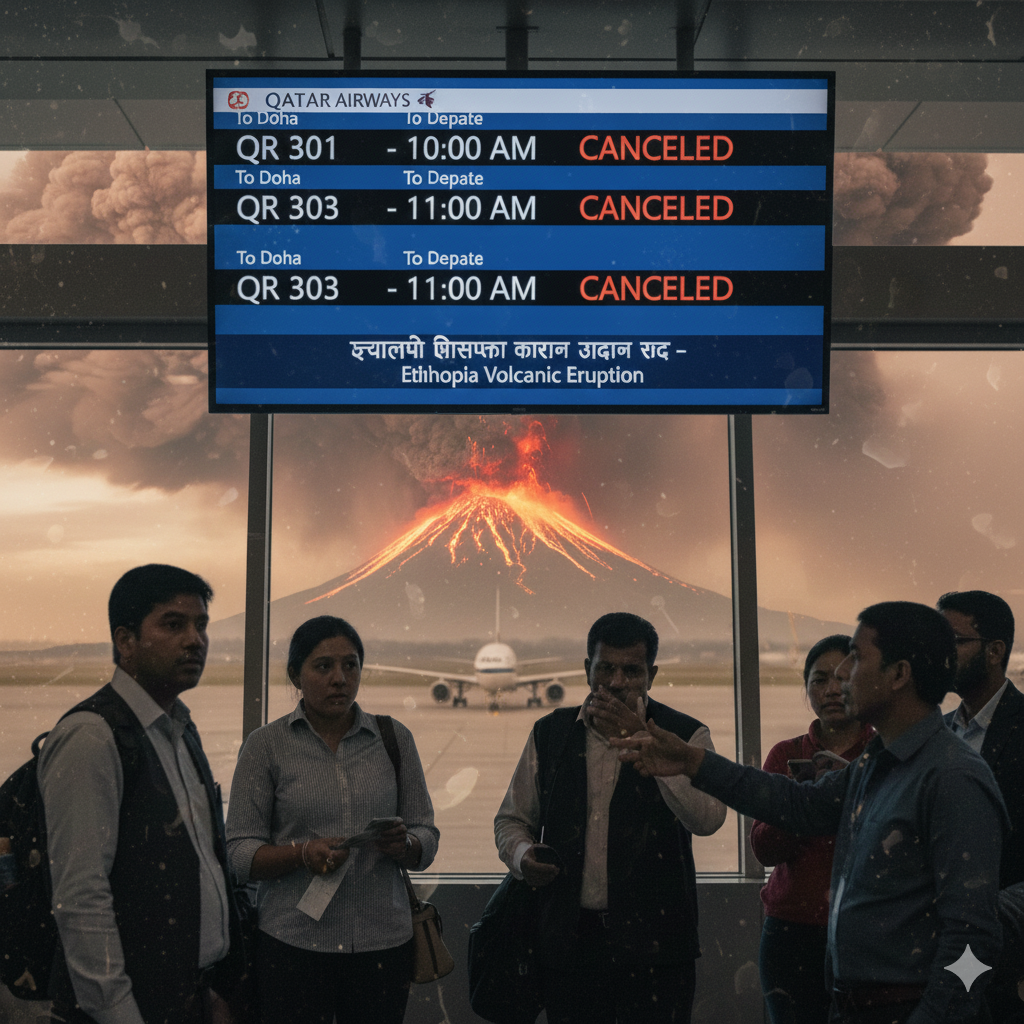
✈️ Flight Cancellations Due to Volcanic Eruption in Ethiopia
Two flights scheduled to depart from Nepal have been canceled due to a volcanic eruption in Ethiopia.
According to the Tribhuvan International Airport (TIA) office, two Qatar Airways flights scheduled for Tuesday (Mangsir 9) at 10:00 AM and 11:00 AM were canceled because of the volcanic ash in the air resulting from the eruption.
TIA spokesperson Rinji Sherpa stated that these flights are now expected to resume after 12:00 AM (midnight) on Tuesday.
”Two flights heading to Qatar have been canceled because of the ash from the volcanic eruption,” Sherpa told a local media source. “The incoming flights from there have also been canceled. The airline company has informed us that all flights will resume after midnight.”
The spokesperson confirmed that no other flights apart from the Qatar Airways services have been disrupted.
Epic and Google agree to settle their lawsuit and change Android’s fate globallyInstead of breaking Google’s app store, Google will let them in.
Epic Games and Google Settle Lawsuit, Paving the Way for Major Android App Store Changes Globally San Francisco, CA – In a significant turn for the mobile app ecosystem, Epic Games and Google have reached a comprehensive settlement to resolve Epic’s high-profile antitrust lawsuit targeting Google’s Play Store practices. The agreement proposes sweeping changes to Android and the Google Play Store that, if approved by the court, will fundamentally alter how apps are distributed and monetized worldwide.
Key Concessions by Google The proposed settlement addresses the core issues raised in Epic’s 2020 lawsuit, which accused Google of illegally monopolizing app distribution and in-app billing on Android.
Reduced Service Fees: Google has agreed to slash its service fees significantly. Developers will now face a maximum commission of 20% for in-app purchases that provide a significant gameplay advantage, and a lower rate of 9% for purchases without such an advantage (like cosmetic items or subscriptions).
Alternative Payment Options: Developers will be allowed to direct users to alternative payment methods both inside apps and via external web links, bypassing Google Play Billing. If a user chooses an alternative payment method, Google may charge a minimal service fee (potentially an additional 5% if Google Play Billing is used for the transaction, though details are complex).
Opening Up to Rival App Stores: Perhaps the most impactful change is the introduction of a program for “Registered App Stores.” Under this new system, alternative app stores that meet specified security and safety standards will be easier for users to download and install directly onto their Android devices, effectively dismantling the friction and “scare screens” that previously discouraged users from sideloading.
Global Reach: Crucially, these significant changes are proposed to be implemented globally and remain in effect through June 2032, extending far beyond the initial US-centric focus of the court injunction.
Reaction from Epic Games Epic Games CEO Tim Sweeney publicly praised the agreement, calling the proposal “awesome” and stating that it “genuinely doubles down on Android’s original vision as an open platform.” This positive reception marks a stark contrast to Epic’s ongoing legal battles with Apple.
Next Steps The agreement is not yet final. The proposed settlement has been filed with U.S. District Judge James Donato, who presided over the original jury trial that found Google liable in late 2023. The companies are scheduled to meet with Judge Donato to discuss the proposal, and his final approval is required for the changes to take effect.
Of course! Here is the article rewritten in clear, professional English, optimized for a WordPress site like “koiralap.”
Harnessing an Advanced Photography System
This device boasts a professional-grade camera system designed for every scenario, from expansive landscapes to detailed close-ups.
Camera Features:
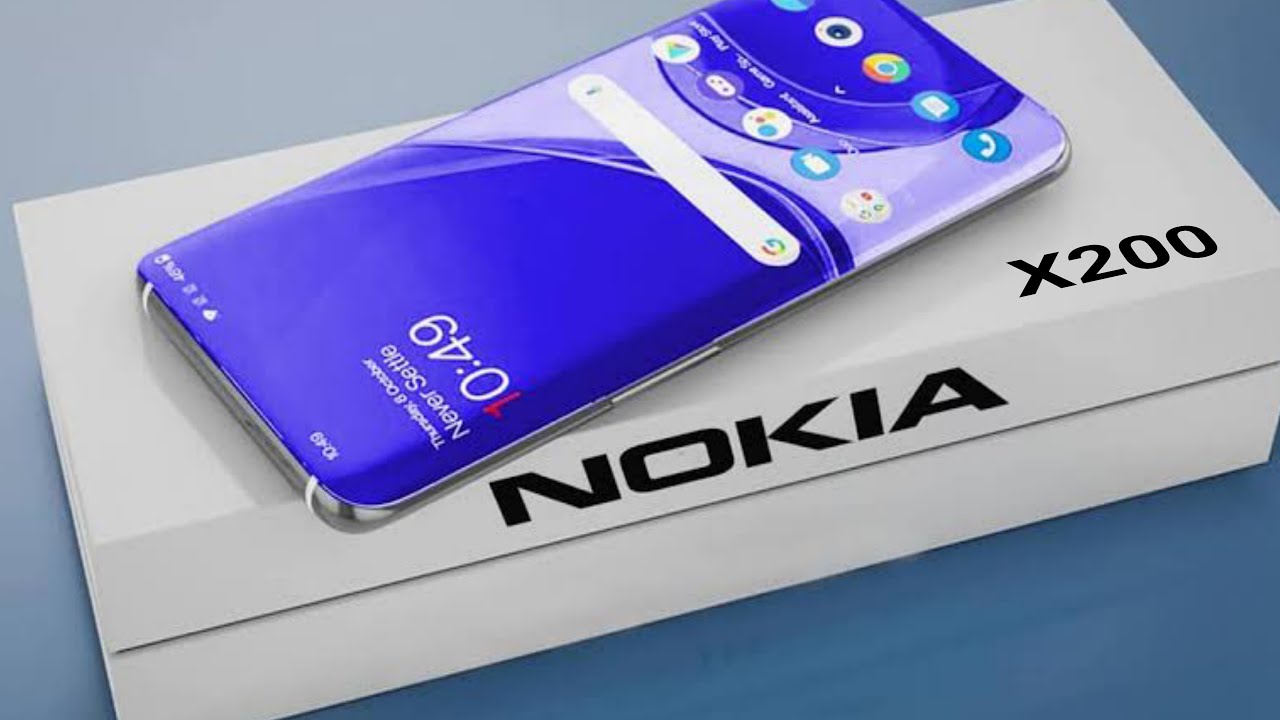
200MP Main Sensor: With ZEISS optics for exceptional clarity and color accuracy.
50MP Ultra-Wide: Captures a massive 120-degree field of view.
12MP Telephoto: Offers 5x optical zoom for lossless long-range shots.
Night Mode: Advanced computational photography for stunning low-light performance.
Pro Mode: Full manual controls for seasoned photographers.
8K Video: Record incredibly detailed video at 30fps.
Performance Benchmarks and Gaming Prowess
Powered by the top-tier Snapdragon® 8 Gen 3 processor, it delivers a seamless and powerful experience for everything from multitasking to intensive gaming.
Performance Test
Score/Result
AnTuTu Benchmark
1,800,000+ points
Geekbench 6 (Single)
2,200+ points
Geekbench 6 (Multi)
6,800+ points
3DMark Wild Life
16,000+ Graphics Score
Genshin Impact
60fps on highest settings
PUBG Mobile
90fps with Ultra HD graphics
Display Technology and Visual Experience
Immerse yourself in a premium visual experience powered by cutting-edge LTPO AMOLED technology.
Display Highlights:
144Hz Adaptive Refresh Rate: Buttery-smooth scrolling and responsive gaming.
2K+ Resolution: Crystal-clear 3200 x 1440 pixel density.
1600 Nits Peak Brightness: Excellent visibility even in direct sunlight.
HDR10+ Support: For a cinematic video experience with enhanced contrast.
Color Accuracy: 100% DCI-P3 coverage for true-to-life colors.
Eye Protection: Built-in blue light filtering for reduced strain.
Battery Life and Charging Technology
Stay powered all day and recharge in minutes with advanced battery management and ultra-fast charging.
Power Management:
5500mAh Capacity: All-day battery life on a single charge.
120W Wired Charging: Reach 80% charge in just 15 minutes.
50W Wireless Charging: High-speed wireless power convenience.
15W Reverse Charging: Charge your other devices on the go.
AI Power Optimization: Smart software for extended battery health.
Fast Charger In-Box: 120W adapter included.
Software Experience and AI Features
Enjoy a clean, intuitive, and secure user experience with a pure version of Android enhanced by Nokia’s software expertise.
Software Highlights:
Pure Android 14: A bloatware-free, streamlined interface.
AI Assistant: An advanced personal helper for smart device management.
Privacy Controls: Enhanced data security and user control.
Update Guarantee: 5 years of Android OS and security updates.
Nokia OZO Audio: Immersive 3D spatial sound capture and playback.
Security: Regular monthly security patches.
5G Connectivity and Network Performance
Experience the next generation of speed and reliability with comprehensive global connectivity support.
Connectivity Features:
5G Band Support: Extensive global 5G band compatibility.
Wi-Fi 7: Connect to the latest wireless standard for extreme speeds.
Bluetooth 5.4: For improved audio quality and connectivity.
NFC: Enables secure contactless payments.
Dual SIM 5G: 5G support on both SIM card slots.
Satellite Connectivity: Emergency communication when off the grid.
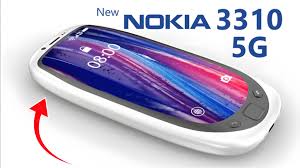
Nokia 3310 Relaunch: Iconic Feature Phone Returns with Modern Upgrades, Preserving Durability and Timeless Appeal
The tech world was rocked when HMD Global announced the relaunch of the legendary Nokia 3310. One of the most cherished mobile phones in history is back, reimagined with contemporary enhancements while retaining the durability and simplicity that made it an icon. The revamped Nokia 3310 appeals to consumers looking for a straightforward mobile experience in today’s tech-heavy world. It’s more than just a product launch; it’s a revival of the enduring charm of reliable, easy-to-use technology.
1. Historical Legacy and Cultural Impact
The original Nokia 3310, first launched in September 2000, became an instant success, selling over 126 million units worldwide and solidifying its place as one of the best-selling mobile phones in history. Known for its extraordinary durability, the 3310 became a symbol of robustness in the mobile phone industry. Over the years, it earned legendary status, especially on the internet, where memes and jokes about its “indestructible” nature became viral.
Original Nokia 3310 Legacy:
Launch Year: September 2000
Global Sales: 126 million units
Production Period: 2000-2005
Cultural Status: Internet legend for durability
Successor Models: Nokia 3410, Nokia 3510
2. Modern Relaunch Strategy and Market Positioning
HMD Global took the world by surprise when they revealed the modernized Nokia 3310 at Mobile World Congress 2017 in Barcelona. Priced at €49, the updated 3310 targeted nostalgic consumers while appealing to those seeking a “digital detox” from smartphones. The relaunch was carefully crafted to capture a market that values simplicity and durability over the complexities of modern smartphones.
Relaunch Timeline & Key Events:
Date
Event
Price Point
February 2017
MWC Barcelona Announcement
€49
October 2017
3G Version Launch
€69
January 2018
4G Version (China Only)
Varies
2023-Present
Continued Production
€59-79
The strategic focus was on regions where feature phones are still popular, and where customers value simplicity and functionality over the complexity of modern smartphones.
3. Technical Specifications and Modern Enhancements
The new Nokia 3310 blends nostalgic design with modern features to cater to today’s consumers. While retaining its signature look, the revamped 3310 integrates new technologies that appeal to those who seek a straightforward mobile experience.
Modern Nokia 3310 Specifications:
Display: 2.4-inch polarized curved color screen
Camera: 2MP rear camera with LED flash
Storage: 16MB internal, expandable via microSD
Connectivity: Dual SIM support, Bluetooth
Battery: 1200mAh with exceptional battery life
Operating System: Series 30+ platform
One of the key updates is the device’s impressive battery life, a hallmark of the original 3310. The addition of a rear camera and expanded storage via microSD card also brings the device into the modern age without sacrificing its signature simplicity.
4. Why the Nokia 3310 Resonates Today
In a world dominated by smartphones, the Nokia 3310 has carved a unique niche for itself. Its resurgence is a reminder of the power of simplicity. The modernized 3310 is aimed at people who want a break from the constant connectivity and complexity of smartphones, offering them an opportunity to reconnect with the basic, reliable features of mobile technology.
Whether it’s for nostalgia, digital detox, or simply the appeal of a more straightforward phone, the Nokia 3310’s comeback proves that there is still room for a classic in the age of advanced smartphones.
The Nokia 3310 continues to prove that some icons never fade away. With its enduring legacy, modern updates, and unmatched durability, it remains a timeless choice for users who prioritize reliability over all else.